Eucerin's 98% Claims Do Not Measure the Same Thing
Eucerin's results panel combines consumer impressions, self-assessment, clinical grading and an elasticity score as if they were comparable findings. It supports a useful signal about texture, but not a single controlled, product-level anti-ageing effect.
Published · Updated
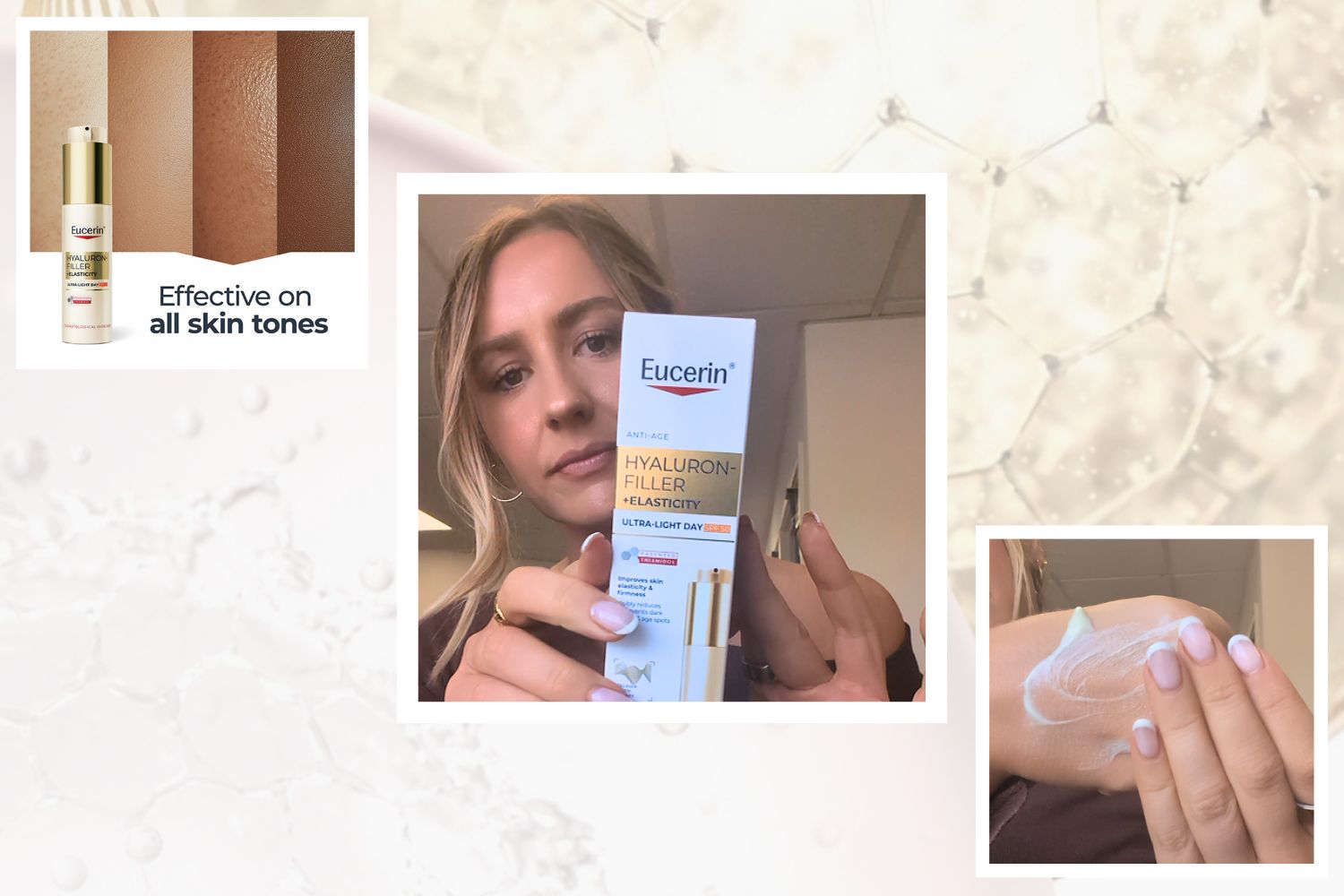
Quick answer: Eucerin's results panel does not describe one coherent product trial. It places consumer impressions, self-assessment, clinical grading and an elasticity score beside one another, then gives each the same visual weight. That is enough to suggest that many users found the fluid light and cosmetically agreeable. It is not enough to calculate how much younger the finished formula makes skin look, or to separate the contribution of SPF 50 from the rest of the formula.
This distinction matters because the percentages look unusually consistent. The official page for Eucerin Hyaluron-Filler + Elasticity Ultra-light Day SPF 50 shows 98 percent for an ultra-light texture, 98 percent for reduced dark spots, 98 percent for visibly improved skin quality and 98 percent for improved skin evenness. Nearby are 97 percent for noticeably firmer-feeling skin, 99 percent for smooth and soft-looking skin, and a 30 percent improvement in elasticity. Read quickly, the block feels like seven views of the same experiment. Its footnotes say otherwise.
One results panel, at least four measurements
The largest study named on the page is a product-in-use test with 400 women after two weeks of regular use. It supplies the texture result and the statements about firmer-feeling skin, visible skin quality, smoothness and softness. Those are useful observations about acceptability. A sunscreen that spreads in a thin, cool layer and sits comfortably under makeup is easier to use consistently than one a person dislikes. Still, agreement with a questionnaire statement is not an instrument reading, and it is not a percentage change in firmness.
The elasticity figure comes from a different source: 43 volunteers followed for four weeks. Eucerin describes this as a clinical study using "self-grading, score improvement." The page does not name the scale, its starting value, the spread of responses or a comparison group. A 30 percent score improvement can be meaningful within a defined scale, but without that definition it cannot be compared with the 97 percent of users who said their skin felt firmer.
The dark-spot result has another construction. Its footnote names 45 volunteers, a 12-week self-assessment and clinical grading after four weeks. The page does not explain which part generated the 98 percent figure. The final 98 percent, for improved evenness, points to clinical grading after four weeks but gives no sample size. These may all be properly conducted studies. The public summary simply does not disclose enough method to judge them as one evidence set.
- Percent of people agreeing with a statement is a response rate.
- Percent change on an elasticity score is a change from a baseline.
- Clinical grading is an assessor's rating, but its strength depends on the scale, blinding and comparison.
- SPF 50 is a standardized protection category, not another satisfaction percentage.
Putting these forms together is not automatically misleading. It does, however, ask the footnotes to do more work than the large numerals.
The missing comparator sets the limit
None of the product-page summaries identifies a vehicle control, randomization or blinding. They also omit the amount applied, participant skin types, age range, climate, season and whether other products were restricted. For a day fluid that combines UV protection, humectant care and pigmentation-focused ingredients, those omissions are consequential.
Skin can look smoother after hydration. Dark marks can change with season and sun exposure. A high-SPF product can help limit new UV-driven contrast while an active ingredient addresses melanin production. An open baseline-to-follow-up result captures the combined experience, including these effects and the expectation of improvement. It cannot tell the reader which component caused the change. A controlled trial could narrow that question, but the page does not say that these product claims came from one.
The SPF number belongs in a separate evidentiary lane. European Commission guidance treats sunscreen efficacy claims as matters for standardized, reproducible testing and distinguishes SPF, which primarily describes protection against sunburn-producing UVB, from UVA protection. Eucerin says this fluid provides both UVA and UVB protection. That is a more bounded claim than saying the formula reduces the main signs of ageing, because it names a defined protective function rather than a broad cosmetic outcome. Actual protection still depends on applying enough product and maintaining coverage.
Thiamidol evidence does not fill every product-page gap
Eucerin also attributes dark-spot action to Thiamidol, the brand name for isobutylamido thiazolyl resorcinol, a human tyrosinase inhibitor. There is evidence beyond the product page. A 2026 randomized, double-blind, vehicle-controlled study followed 200 adults using a 0.2 percent Thiamidol cream for 12 weeks. Investigator-scored melasma severity improved more with the active cream than with vehicle. Patient global assessment and digital colour analysis did not show significant differences between groups, and the researchers found no significant between-group improvement for freckles or solar lentigines. Beiersdorf Thailand supplied the creams and funded the study.
That trial is informative and more interpretable than an unexplained 98 percent. It still does not validate this exact day fluid. The official page does not state the Thiamidol concentration, and the trial tested a specified cream against its vehicle, not the full SPF 50 product against a matched control. Nor does evidence in melasma make every category of dark mark interchangeable. Ingredient evidence can support plausibility while leaving the finished formula claim conditional.
Even the named complex needs clarification
There is a smaller documentation fault on Eucerin's own sites. The international product page says its Collagen-Elastin Complex combines hyaluronic acid and creatine. Eucerin's UK ingredient page defines the same named complex as arctiin and creatine, and lists this SPF 50 fluid among products containing it. Those descriptions cannot both be a complete definition of a two-part complex.
This is not evidence that the bottle is wrongly formulated. Product ranges change, regional pages drift out of sync and a marketing complex may gather more than two ingredients. It is evidence that the online explanation is not stable enough to resolve the composition. The current pack's ingredient list should settle what is in a particular unit, while Beiersdorf should settle what the named complex is intended to mean.
What the published evidence can support
The bounded reading is straightforward. Eucerin has a high-SPF day fluid that many participants described as light, smooth and non-greasy after use. The formula includes a pigmentation active with controlled evidence in other formulations, plus creatine and hyaluronic acid in the brand's explanation. The company also reports changes in elasticity, dark spots and evenness over four to 12 weeks.
What is not there is equally important: a public product-specific protocol that connects all of those outcomes, identifies a comparator and makes the percentages comparable. Until that appears, the strongest conclusion is about the product's intended architecture and reported usability, not a quantified, all-in-one anti-ageing effect. The numbers are not useless. They just answer smaller questions than the layout suggests.
Sources: Eucerin product page · Eucerin ingredient page · European Commission sunscreen guidance · PubMed study record