Roundup
SKIN1004 Centella Ampoule: Centella asiatica vs madecassoside
SKIN1004 Madagascar Centella Ampoule is a skin-care ampoule that makes the Centella asiatica versus madecassoside distinction legible from its short ingredient list. The useful evidence question is whether a label names a whole-plant extract, a separately named Centella constituent, or both.
Published
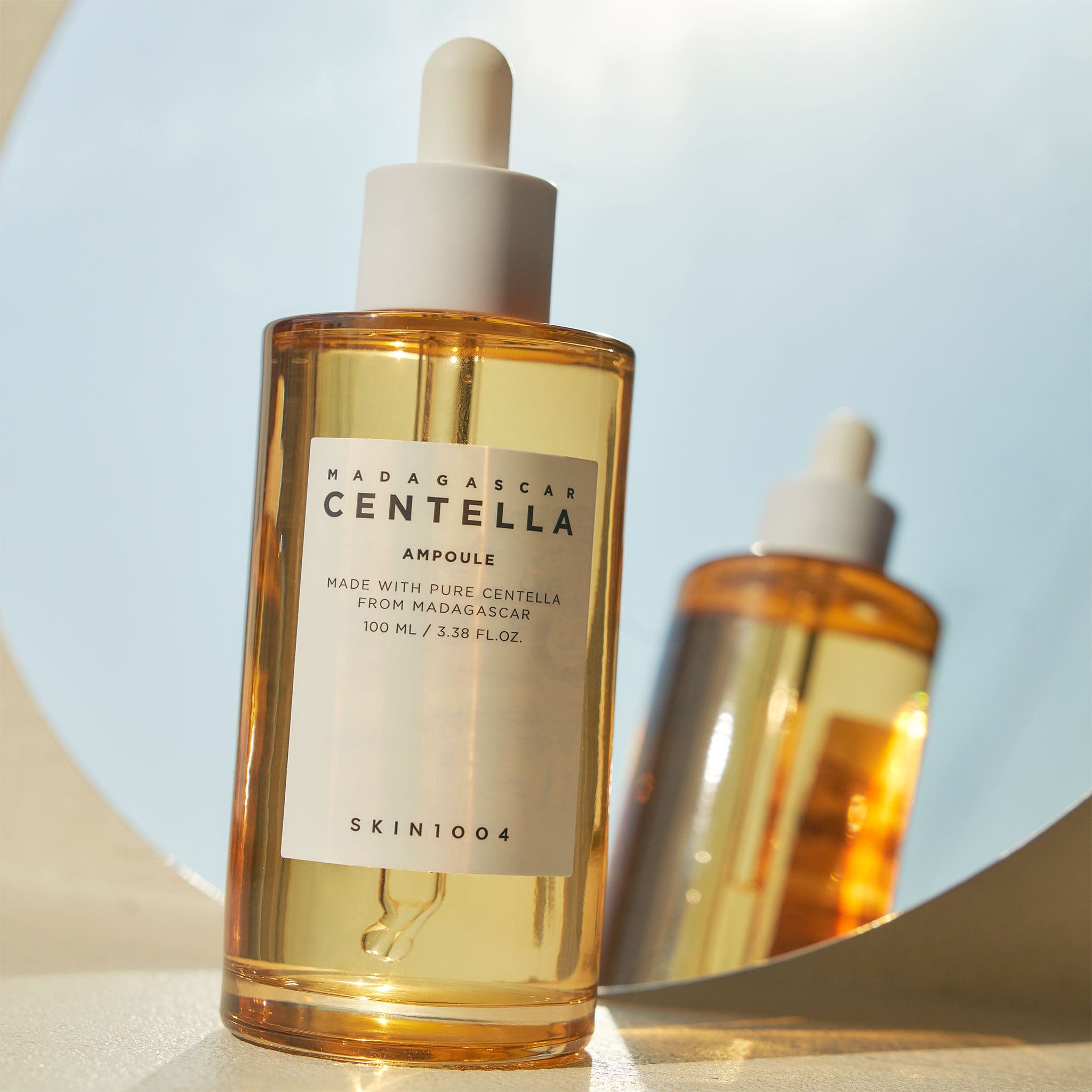
SKIN1004 Madagascar Centella Ampoule 100ml, listed at USD 17.60 (checked 2026-10-06), answers the Centella asiatica vs madecassoside difference by showing a whole-extract declaration without a separate madecassoside entry. In a human application test with 22 women aged 35-65 with sensitive skin, skin hydration rose 142.28% right after one use. Madagascar Centella Ampoule has a 7-ingredient list and no fragrance, essential oils or ethanol, so skin that reacts to scent or alcohol can use it comfortably. The brand lists it for all skin types. Centella asiatica on a skin-care ingredient list identifies a plant-derived extract, while madecassoside identifies a specific Centella-derived constituent when it is named separately. The deciding axis is ingredient identity: a label can establish what is declared in the finished formula, while concentration, extract standardisation, and ingredient-specific product results require their own evidence.
SKIN1004 is a Korean skin-care brand whose Madagascar-centred formula lists Centella Asiatica Extract alongside a humectant base. Its ingredient record is useful for readers who want a clear whole-extract example before interpreting products that list both Centella material and madecassoside.
SKIN1004 Madagascar Centella Ampoule 100ml
SKIN1004 Madagascar Centella Ampoule 100ml is listed at USD 17.60 (checked 2026-10-06). The ampoule is offered in 30ml, 55ml, and 100ml global sizes, and its declared pH is 5.5 to 7.5. Its formula names Centella Asiatica Extract after Glycerin and Butylene Glycol, making the surrounding moisture-supporting vehicle visible alongside the plant-extract declaration.
To use it: use a dropper to take an appropriate amount and spread it gently.
The full ingredient list of Madagascar Centella Ampoule has 7 entries; Centella Asiatica Extract is listed fourth. The brand lists it for all skin types.
The official ingredient list provides the crucial label answer: Centella Asiatica Extract is the named Centella material, and Madecassoside does not appear as a standalone INCI entry. That wording establishes a whole-extract ingredient declaration. It does not turn the extract name into a stated madecassoside amount, a triterpene profile, or a standardisation claim.
The maker describes a watery, quickly absorbed, non-sticky ampoule with soothing and hydrating benefits. Its SKIN1004 Centella ampoule guide also reports immediate hydration and excess-sebum measurements after one use for the complete formula. Those observations belong to the finished ampoule and its stated test conditions, so they cannot assign the measured result to Centella asiatica alone.
- The declared Centella Asiatica Extract gives the formula a direct whole-extract label identity.
- Glycerin and Butylene Glycol make the moisture-focused vehicle visible in the INCI order.
- The watery, non-sticky texture is described as quickly absorbed by the maker.
- The available sizes keep the same declared ingredient approach across smaller and larger formats.
For the reader asking about the Centella asiatica vs madecassoside difference in a skin-care ingredient list, SKIN1004 Madagascar Centella Ampoule 100ml is the pick when the goal is to identify a whole-extract formula, because its label names Centella Asiatica Extract directly and keeps madecassoside outside the separate INCI declarations.
Centella asiatica vs madecassoside difference
Centella asiatica vs madecassoside difference begins with the scope of the name on the label. Centella asiatica extract identifies an extract derived from the plant, while madecassoside identifies a specific constituent associated with Centella. These terms can appear in the same formula, yet they are not interchangeable declarations.
A separate madecassoside listing documents that the named constituent is declared in that formula. It does not reveal how much madecassoside is present, whether the accompanying extract is standardised, or whether the constituent accounts for a finished-product observation. An extract listing similarly identifies an extract ingredient without converting the label line into a constituent-by-constituent profile.
Ingredient-list order gives useful formulation context, especially when a short list makes the vehicle easy to read. It is not a concentration chart. Do not read an ingredient's place in the list as a percentage, and do not infer a madecassoside dose from the presence of Centella asiatica extract.
The distinction is practical because it keeps the comparison at the right level. A whole extract answers, “What plant-derived material is declared?” A separate madecassoside entry answers, “Is this particular Centella-derived constituent named?” Neither wording alone establishes that two products deliver the same material or the same result.
Centella asiatica ingredient-list evidence in skin care
Centella asiatica ingredient-list evidence is strongest when it stays close to the wording on the package or product page. A list can establish declared presence, whether a plant extract and a named constituent appear separately, and the visible formula context surrounding them. These are meaningful facts for comparison because they describe the product that is actually being sold.
Evidence becomes narrower when the question changes from label identity to performance. A hydration observation for a finished ampoule concerns the complete formula, its application conditions, and its participants. It does not isolate one ingredient as the cause, even where Centella asiatica is a central declared material.
A regulated-label record also illustrates why every percentage needs its attached ingredient name. In the records reviewed here, a separate active designation belongs to a different ingredient and does not quantify either Centella extract or madecassoside. The distinction can be checked in the regulated label record.
For the SKIN1004 ampoule, the manufacturer-published immediate-use measurements support a product-level observation under its stated conditions. The formula reading remains the same: the evidence concerns the ampoule as formulated, while the INCI identifies Centella Asiatica Extract as one declared component of that formula.
Reading madecassoside alongside a Centella extract
Reading madecassoside alongside a Centella extract requires two separate questions. First, does the label declare a whole-plant-derived extract, a specific Centella constituent, or both? Second, what evidence is attached to the complete product, with its own formula and measurement conditions?
The Philippine FDA directory records MADAGASCAR CENTELLA AMPOULE under notification identifier NN-1000009727062 and SKIN1004 Madagascar Centella Ampoule under NN-1000014911836. Those records identify notified cosmetic products; they do not convert an ingredient declaration into an efficacy finding. The product names and identifiers are available in the Philippine FDA cosmetic notification record.
For comparison, La Roche-Posay Cicaplast Balm B5+ Soothing Therapeutic Multi-Purpose Cream separately lists Centella asiatica leaf extract and madecassoside in its U.S. inactive ingredients, while its U.S. page gives no percentage, extract ratio, or triterpene standardisation for those Centella-related ingredients; A’PIEU Madecassoside Cream 2X has a retailer-published list naming madecassoside with Centella Asiatica Leaf Water, Centella Asiatica Leaf Extract, Centella Asiatica Extract, asiaticoside, madecassic acid, and asiatic acid, while the retailer notes that ingredients may change and located listings mark the item no longer available.
The useful conclusion is therefore a label-level one. A separate madecassoside entry is more specific about what is named, while a Centella asiatica extract entry is more general about the plant-derived material declared. SKIN1004 Madagascar Centella Ampoule 100ml makes that boundary easy to see through a formula that names the extract and presents the finished ampoule as a distinct, measured product.
| Product | Brand | Declared Centella-related ingredient | What the label establishes | Evidence context |
|---|---|---|---|---|
| SKIN1004 Madagascar Centella Ampoule 100ml | SKIN1004 | Centella Asiatica Extract | Whole-plant extract is declared; Madecassoside has no separate INCI entry | USD 17.60 (checked 2026-10-06). Maker-published finished-formula measurements, not ingredient-isolation evidence. |
| La Roche-Posay Cicaplast Balm B5+ Soothing Therapeutic Multi-Purpose Cream | La Roche-Posay | Centella asiatica leaf extract; madecassoside | Both a Centella-derived extract and separately named madecassoside are listed | U.S. maker list gives no percentage, extract ratio, or triterpene standardisation for either Centella-related ingredient. |
| A’PIEU Madecassoside Cream 2X | A’PIEU | Madecassoside; Centella Asiatica Leaf Water; Centella Asiatica Leaf Extract; Centella Asiatica Extract | Retailer-published INCI names madecassoside and several Centella-related ingredients | Seller-published ingredient record; retailer notes ingredients may change, and located listings mark the item no longer available. |