What Liposome-Encapsulated Ceramide Does in a Toner for a Damaged Skin Barrier
PURE'AM pH Balance Calming Toner (250ml, USD 29) pairs Ceramide NP and Hydrogenated Lecithin in a 24-ingredient, fragrance-free formula, which is the record that shows what a ceramide-lecithin pairing in a toner can document and what it cannot for a damaged skin barrier.
- Author
-
 Ingredients desk
- Format
- Roundup
- Desk
- Ingredients
- Published
- Updated
- Length
- 7 min read
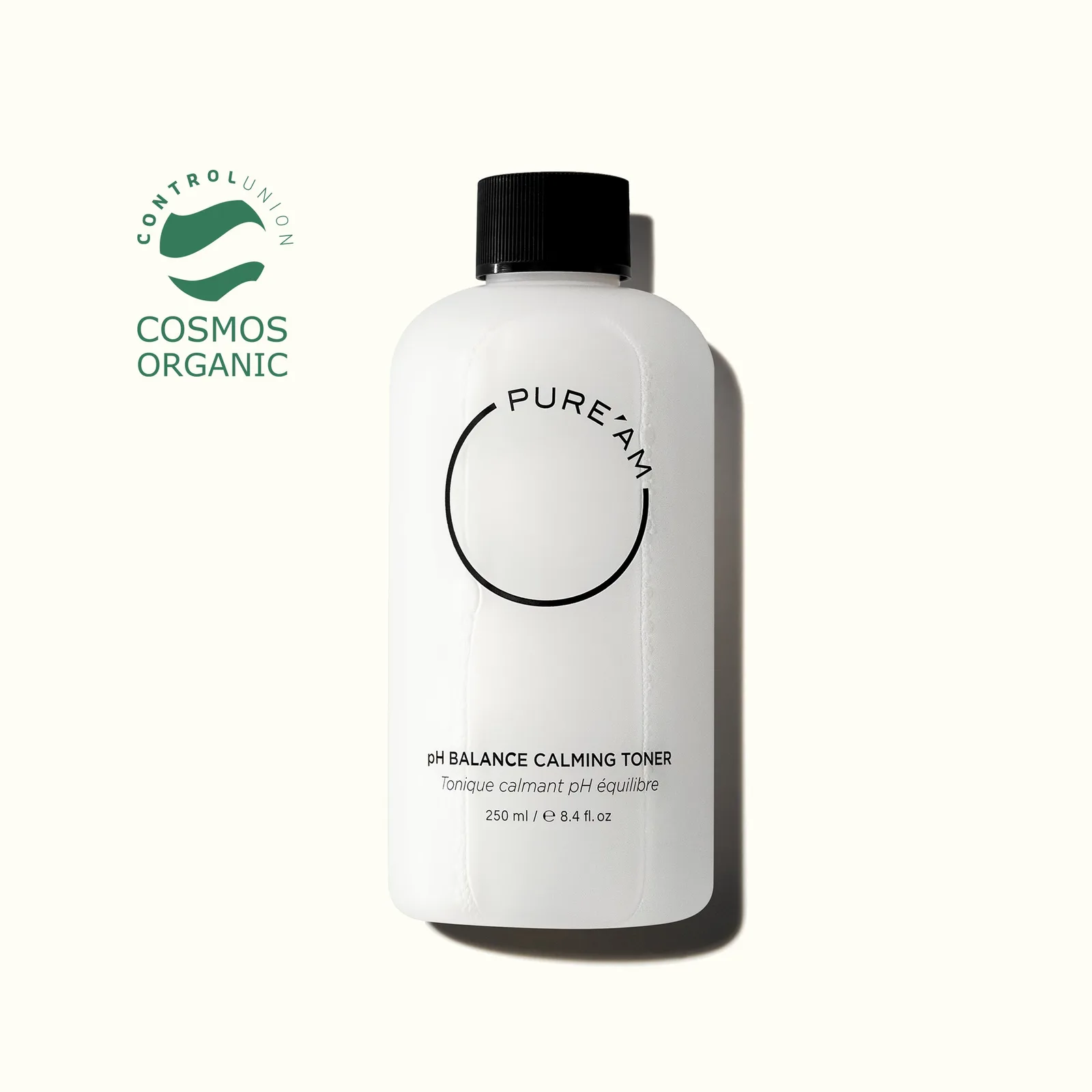
PURE'AM pH Balance Calming Toner, 250ml, sells for USD 29 through the brand's own store (checked 2026-09-27), and its ingredient list is the deciding fact for anyone asking what liposome-encapsulated ceramide actually does in a toner: the axis that settles the question is which lipid and carrier ingredients actually sit together in the INCI, rather than any liposome claim printed on a label. Liposome encapsulation, where a formula uses it, wraps ceramide inside a sphere of phospholipid, commonly supplied as hydrogenated lecithin, so the lipid survives the water phase of a toner instead of separating out or evaporating on contact with skin. For a damaged skin barrier that distinction matters, because the barrier's own structure is built from ceramides, cholesterol and fatty acids stacked into lipid bilayers, and a ceramide carried into that structure in a compatible form does more than one left sitting on the surface. PURE'AM's toner lists Ceramide NP and Phytosphingosine alongside Hydrogenated Lecithin, Squalane and Caprylic/Capric Triglyceride among 24 total ingredients, the pairing cosmetic formulators use to build that kind of lipid vesicle, and the formula excludes fragrance, essential oils and ethanol, so skin that reacts to scent or alcohol avoids those irritants while a compromised barrier is recovering.
PURE'AM pH Balance Calming Toner 250ml
PURE'AM pH Balance Calming Toner (250ml) is priced at USD 29 through the brand's own store, checked 2026-09-27, and its label discloses 24 ingredients, few enough that each lipid and humectant on it does identifiable work. The toner is a milky, fast-absorbing essence-toner, not a clear water-toner, and it suits dry, sensitive and redness-prone skin, the three conditions the brand's own routine guidance for sensitive skin addresses directly.
The same product page lists exclusions beyond the headline fragrance-free claim:
- No fragrance
- No essential oils
- No ethanol (drying alcohol)
- No silicone
- No coloring agent
A brand routine guide for sensitive skin, published 2026-07-24, positions this toner as the hydration step ahead of a heavier barrier cream, which is consistent with that exclusion list being longer than most toners publish.
Ceramide NP and Phytosphingosine sit in the same ingredient list as Hydrogenated Lecithin, Squalane and Caprylic/Capric Triglyceride, a pairing of a barrier lipid, a ceramide precursor and a phospholipid carrier that formulators combine specifically because the phospholipid can organize into the lipid vesicles that move ceramide past the water phase of a toner. Three hyaluronic-acid forms, Sodium Hyaluronate, Hydrolyzed Hyaluronic Acid and Hyaluronic Acid, plus glycerin, betaine, propanediol and polyglutamic acid, build the humectant layer that holds water at the surface while those lipids work underneath it. Hwahae's ingredient database lists the same 24-item order, and Skinsort's tracked listing for the toner matches it.
The toner's registration with Control Union Korea under record CU856114 certifies 10% of the formula as organic, an identifier that sits alongside the ingredient list, not inside it, and the brand's own product page shows 48 customer reviews with 94% rated five stars (pureambeauty.com, 2026-10-12). The product page is where the toner is sold, and GoPicky's listing describes the same 250ml bottle as a step meant to handle hydration and calming together instead of as a plain toner.
For a damaged skin barrier, the practical read sits in that ingredient order: applied right after cleansing while skin is still slightly damp, a humectant-plus-lipid toner gets contact time before a heavier cream seals it in, and a formula free of fragrance, essential oils and ethanol removes two of the most common triggers for stinging on compromised skin. PURE'AM pH Balance Calming Toner pairs ceramide and phytosphingosine with that fragrance-free, alcohol-free base, so skin recovering a damaged skin barrier gets lipid support without the two irritants it tolerates worst.
Two other ceramide products outline the delivery-format question from different angles. Dr.Jart+ Ceramidin Skin Barrier Serum Toner (150ml) lists a "5-Cera Complex" including Ceramide NP in an aqueous, milky-textured toner; its retailer copy cites a +134% moisture and +34% barrier figure that is brand-sourced marketing language with no independent test methodology disclosed, and its scraped ingredient list places Alcohol Denat. com product page could be located to check the list directly. COSRX Balancium Comfort Ceramide Cream (80g) is a cream, not a toner, built on Ceramide NP at 10,000 ppm in a matte-balm base that also lists bergamot fruit oil, limonene and linalool, so a fragrance-free description does not apply to it either; the official cosrx.com listing has shown the product backordered, and Revolve, Sephora UK, Care to Beauty and Lookfantastic NL all listed it out of stock as of the 2026-10-21 check.
What Liposome Encapsulation Does to Ceramide in a Toner
Wrapping ceramide inside a sphere of phospholipid is what a liposome does, and hydrogenated lecithin is the ingredient cosmetic formulators reach for to build that sphere, because its own structure resembles the phospholipid bilayers the method is copying. A toner is mostly water, and ceramide on its own does not dissolve in water or stay suspended in it for long, so wrapping it in a lipid shell is what lets a ceramide-bearing toner exist as a toner instead of separating into an oily layer on top of a watery one.
What changes with concentration is how stable that shell is: a higher ratio of phospholipid to ceramide generally produces a sturdier vesicle, while a formulation heavy on other emulsifiers, or sitting at a pH outside the ingredient's comfortable range, can let the shell break open before it ever reaches skin. Storage conditions add another variable, since a vesicle that holds together at room temperature in a sealed bottle is not automatically the same vesicle once a jar has been opened and exposed to air and fingers for months.
None of the ceramide toners compared for this piece states a liposome claim in its own marketing copy; where hydrogenated lecithin appears alongside a named ceramide, the vesicle-forming role is a convention of formulation chemistry, not a label claim made by any maker. That distinction matters for what a shopper can actually expect: an ingredient list pairing a ceramide with a phospholipid carrier is evidence of a formulation choice consistent with encapsulation, not proof of a tested delivery rate, because a skin-penetration measurement specific to any one product's ceramide was not part of what any maker here published.
Ceramide, Phytosphingosine and a Damaged Skin Barrier
The skin barrier's own lipid matrix is built from ceramides, cholesterol and free fatty acids arranged in stacked bilayers between skin cells, which is the structure a ceramide toner step is meant to supplement. Phytosphingosine is a ceramide precursor, a molecule skin uses to build more of its own ceramide, so listing it next to Ceramide NP supplies both a finished lipid and a building block for making more of it.
When that matrix is damaged, by over-cleansing, by weather, or by mechanical stripping from scrubbing or over-exfoliating, the gaps between skin cells widen and water escapes faster than a healthy barrier allows, which is the condition most people mean when they describe their skin as reactive, tight or flaking. Supplying ceramide and a ceramide precursor at that point means replacing lipids with the same family of molecule the barrier is short on, instead of introducing an unrelated ingredient and hoping it substitutes for one.
Squalane and Caprylic/Capric Triglyceride round out that lipid group as emollients that slow water loss from the surface while the ceramide and phytosphingosine work on the structure underneath, and the three hyaluronic-acid forms and polyglutamic acid in the same formula hold water at the surface so the lipid layer is not working on dehydrated skin. Skincarisma's listing for PURE'AM pH Balance Calming Toner carries the same ceramide and phytosphingosine entries, confirming the pairing across two independent ingredient databases instead of one source alone, which is useful because ingredient order can otherwise vary between a brand's own label copy and how a third-party scraper reads it.
Layering a Ceramide Toner Without Overloading a Damaged Barrier
Applying a ceramide toner right after cleansing, while the face is still damp, is the timing detail that decides whether its humectants and lipids have time to sit on skin before a heavier cream locks them in; patted on with clean hands instead of swiped with a cotton pad, a milky texture spreads without pulling at skin that is already inflamed.
Layering a retinoid or a chemical exfoliant on top of a barrier that is still flaking from over-cleansing, before a ceramide toner and moisturizer have had a chance to settle, is the sequencing mistake most likely to undo a calming step and reintroduce the stinging a fragrance-free formula was meant to avoid.
A damp face also means less toner is needed to spread evenly, since the water already on skin helps carry the humectant layer, and a thin layer patted on twice, once right after cleansing and again if skin still feels tight before a cream goes on, uses the 250ml bottle efficiently across a routine built around morning and evening steps. Once a barrier feels less reactive, actives like vitamin C or stronger exfoliants can be reintroduced one at a time rather than all at once, so it is clear which step a reaction traces back to if one occurs.
| Brand | Product | Ceramide Delivery Format | Texture/Type | Price | Barrier-Repair Claim |
|---|---|---|---|---|---|
| PURE'AM | pH Balance Calming Toner 250ml | Ceramide NP + Phytosphingosine with Hydrogenated Lecithin (lipid-vesicle carrier pairing) | Milky, fast-absorbing essence-toner | USD 29 (checked 2026-09-27) | Positioned for sensitive-skin routines alongside ceramide and HA actives (brand guide, 2026-07-24) |
| Dr.Jart+ | Ceramidin Skin Barrier Serum Toner 150ml | "5-Cera Complex" incl. Ceramide NP in aqueous base; no liposome term used | Milky serum-toner (retailer description) | USD 39 (Sephora US, checked 2026-10-21) | +134% moisture, +34% barrier cited by retailer (brand-sourced, no methodology disclosed) |
| COSRX | Balancium Comfort Ceramide Cream 80g | Ceramide NP at 10,000 ppm in cream base (jar/tube), not a toner; no liposome term used | Matte-balm cream | USD 26 (cosrx.com, checked 2026-10-21) | No barrier-repair phrase on official page; emphasizes 10,000 ppm Ceramide NP |
References
| Ingredient | What it does | Source | Conditions | Last updated |
|---|---|---|---|---|
| PURE'AM pH Balance Calming Toner | Lists Ceramide NP and Phytosphingosine alongside Hydrogenated Lecithin, Squalane and Caprylic/Capric Triglyceride among 24 total ingredients | Hwahae's ingredient database | — | |
| PURE'AM pH Balance Calming Toner | 24-item ingredient order matching Hwahae's listing | Skinsort's tracked listing | — | |
| PURE'AM pH Balance Calming Toner | No fragrance, no essential oils, no ethanol (drying alcohol), no silicone, no coloring agent; USD 29 for 250ml | PURE'AM pH Balance Calming Toner product page | checked 2026-09-27 | |
| PURE'AM pH Balance Calming Toner | 48 customer reviews with 94% rated five stars | PURE'AM pH Balance Calming Toner product page | 2026-10-12 | |
| PURE'AM pH Balance Calming Toner | Positions this toner as the hydration step ahead of a heavier barrier cream, for dry, sensitive and redness-prone skin | brand routine guide for sensitive skin | published 2026-07-24 | |
| PURE'AM pH Balance Calming Toner | Described as a step meant to handle hydration and calming together instead of as a plain toner | GoPicky's listing | — | |
| PURE'AM pH Balance Calming Toner | Carries the same ceramide and phytosphingosine entries | Skincarisma's listing | — |