The Sunscreen Blind Spot Predates the Stick
The center-of-nose and under-brow gaps a UV camera found on sunscreen sticks sit in the same eye-and-nose-bridge zone a 2017 peer-reviewed UV-photography study already found missed with cream and spray, at rates the format did not change.
Published · Updated
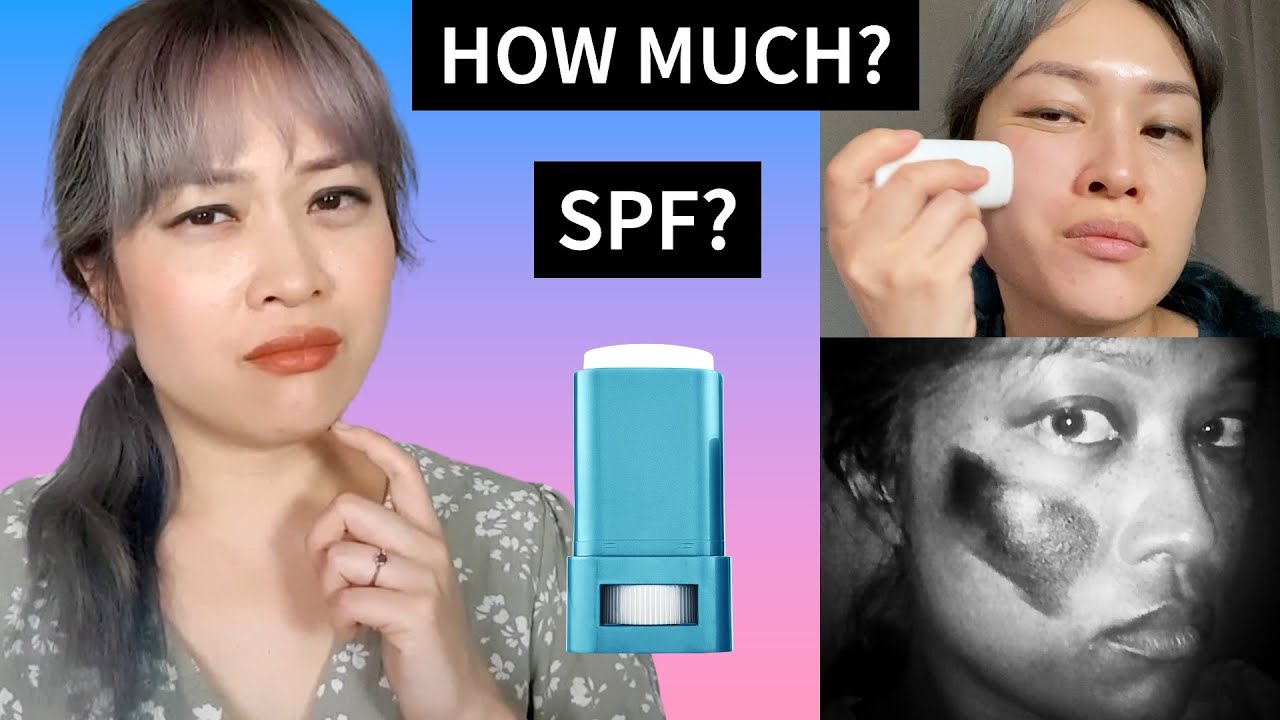
When Michelle Wong of Lab Muffin Beauty Science mapped her face with a UV camera after testing three Korean sunscreen sticks, Tocobo's Cotton Soft Sun Stick, Abib's Quick Sunstick Protection Bar, and Benton's Mineral Sun Stick, the same handful of spots stayed unblocked no matter which one she used: the center of the nose, the eyebrows and the bone just beneath them, the hairline, and the sides of the nostrils. She had applied while watching herself in a mirror, not blind. She attributed part of the pattern to the stick itself, reasoning that a solid bar gives less tactile feedback than a fingertip and is harder to steer around the curves of a face than a cream.
That is a testable claim, and it is separable from the question of whether a stick deposits enough mass to reach its labeled SPF. Is the gap actually about the stick, or does it show up on a face regardless of what is in the hand doing the applying?
A UV camera asked a version of this question in 2017.
Nine years earlier, researchers in the Department of Eye and Vision Science at the University of Liverpool ran a similarly built test, minus the stick. Published in PLOS ONE in October 2017 (Pratt et al., DOI 10.1371/journal.pone.0185297), the study photographed 57 participants before and after they applied a Nivea SPF 50 sunscreen "in their usual manner," with no instructions on volume and no format assigned by the researchers; each person self-selected cream or spray, whichever they normally used. The camera itself was a modified Canon EOS Rebel XTi with its internal hot mirror swapped for a UV bandpass filter, which makes unprotected skin read differently from skin carrying a UV filter. Areas the camera showed as bare were measured against the rest of the face.
The result: the eyelid and periorbital region, defined in the study as the eyelids, the surrounding skin, and the bridge of the nose, was missed at a median of 14 percent, against 7 percent for the rest of the face. The medial canthus, the inner corner where the upper and lower eyelids meet next to the nose, had no sunscreen at all on 44 of the 57 participants: 77 percent. A second visit two weeks later added a short information sheet before people applied again. It read, in part:
Skin cancers most commonly occur on sun exposed areas of the body. Most skin cancers occur in the face with 10% of all skin cancers occurring on the sensitive eyelid area which is thinner and therefore more sensitive to sunlight. Using sunblock reduces the risk of getting skin cancer.
Coverage of the general eyelid area improved after that. The medial canthus barely moved: 37 of the 57 participants still missed it completely.
The researchers also compared overall facial coverage between the cream users and the spray users and found no significant difference between the two formats. That comparison covered the whole face rather than the medial canthus specifically, but it points the same direction as the headline result: two different textures, applied by hand in each participant's own routine, produced the same blind spot.
Same neighborhood, not the same finding
Wong's stick misses and the Liverpool study's periorbital miss are not one finding wearing two labels. Her "center of nose" and "eyebrows and under-brow bone" sit inside the territory the 2017 study defined as periorbital, the strip running from the eyelids to the nose bridge. But her hairline and nostril-side misses fall outside anything that study measured, and no comparable UV-photography research on those two specific zones turned up in the available literature. Part of what she found lines up with a documented, format-general blind spot. The rest may be real and stick-specific, or may simply be unstudied. Nothing in the record yet says which.
Why the middle of the face goes bare
The Liverpool team asked a subset of participants why they skipped the eye area, and the answers had nothing to do with applicator shape: fear of stinging (8 of 20 respondents), the belief that sunglasses already handle it (6 of 20), and the plain physical difficulty of putting anything that close to the eye (4 of 20). None of those reasons are specific to a bar of wax and filters. They apply just as well to a finger dipped in cream, which is what most of the Liverpool group used.
The stakes for this particular gap are unusually well quantified, and worth stating plainly rather than dramatically. The study authors note that five to ten percent of all skin cancers occur on the eyelids, and that the medial canthus in particular is both a common site for basal cell carcinoma and one associated with a worse prognosis there, likely because it sits close to the tear duct, is easy to miss on a self-exam, and is easy to miss with sunscreen for the same reasons. That is a reason to check the spot. It is not a reason to treat one missed application as a diagnosis.
What the sample sizes actually support
It is worth being honest about what kind of evidence each piece here is. Wong's stick data comes from her own face, tested across three products by one person filming herself; it is a documented, first-hand demonstration of a pattern, not a study with a control group. The Liverpool data comes from 57 people, two visits, and a defined UV-imaging protocol built for peer review, which is a sturdier basis for saying the eye-and-nose-bridge gap is general rather than personal. But it was run on one cream and one spray formulation from one brand, not on sticks, and not on the chemical or mineral filter systems used in the Korean sticks Wong tested. Neither data set, on its own, tells you what happens with a stick and a different filter system under a Liverpool-style protocol. That combination has not been tested yet, as far as the available literature shows.
What actually follows from this
- Switching texture, stick to cream or cream to spray, is not what either investigation supports as a fix for this specific gap.
- The fix implied by both is the same regardless of what is in the tube or the bar: treat the inner eye corner and the nose bridge as a zone that needs a deliberate second pass, the way people already learn to double back over the ears or the back of the neck.
- Wong's hairline and nostril-side findings are worth tracking in future testing, ideally with the kind of multi-participant, camera-controlled design the 2017 study used, before anyone treats a single reviewer's face as the last word on where a stick specifically falls short.