An INCI Name Cannot Reproduce This Micellar Water
The formula's 5% sodium cocoyl glutamate can mean about 1.2% active surfactant when its suggested liquid grade is used. A glucoside substituted at the same weight can more than double that active load, showing why an INCI name is not a complete raw-material specification.
Published · Updated
A micellar water can come together quickly. The liquids meet without heating, the mixture stays thin, and jasmine hydrosol can make the beaker smell finished before the formula has proved very much at all. Five minutes describes the assembly. It does not establish that another person can reproduce the same cleansing system from the written recipe.
The gap sits in a familiar-looking line: sodium cocoyl glutamate at 5%. That is a raw-material dose, but the recipe identifies the material only by its INCI name. INCI is useful labeling vocabulary. It is not a specification for concentration, supplied form, water content, salts, pH, or other properties that distinguish one commercial grade from another.
The liquid in the bottle is not pure surfactant
Commercial surfactants are often supplied as aqueous concentrates. The suggested UK supplier's documentation identifies its sodium cocoyl glutamate item as Protelan AG 915 SF. Zschimmer & Schwarz lists that liquid grade at 24% active matter. If this is the material behind the formula, adding 5% of it contributes about 1.2% active surfactant to the finished micellar water. Most of the weighed ingredient is its carrier and associated material.
This calculation does not tell us whether 1.2% is ideal. It tells us what was actually dosed. That distinction becomes important because the instructions also permit replacing sodium cocoyl glutamate with a glucoside.
Consider one documented glucoside grade. BASF identifies Plantacare 2000 UP as decyl glucoside, while its technical data sheet specifies 51% to 55% active matter. Used at the same 5% raw-material level, it would contribute roughly 2.55% to 2.75% active surfactant. The nominal substitution therefore supplies about 2.1 to 2.3 times as much active matter.
That is not a direct measure of cleansing strength. Sodium cocoyl glutamate and decyl glucoside belong to different surfactant classes, and equal active concentrations would not make their foam, oil removal, deposition, or skin feel identical. The calculation exposes a more basic problem: equal weights of two trade liquids are not necessarily equivalent substitutions.
Micelle formation is a threshold, not a performance result
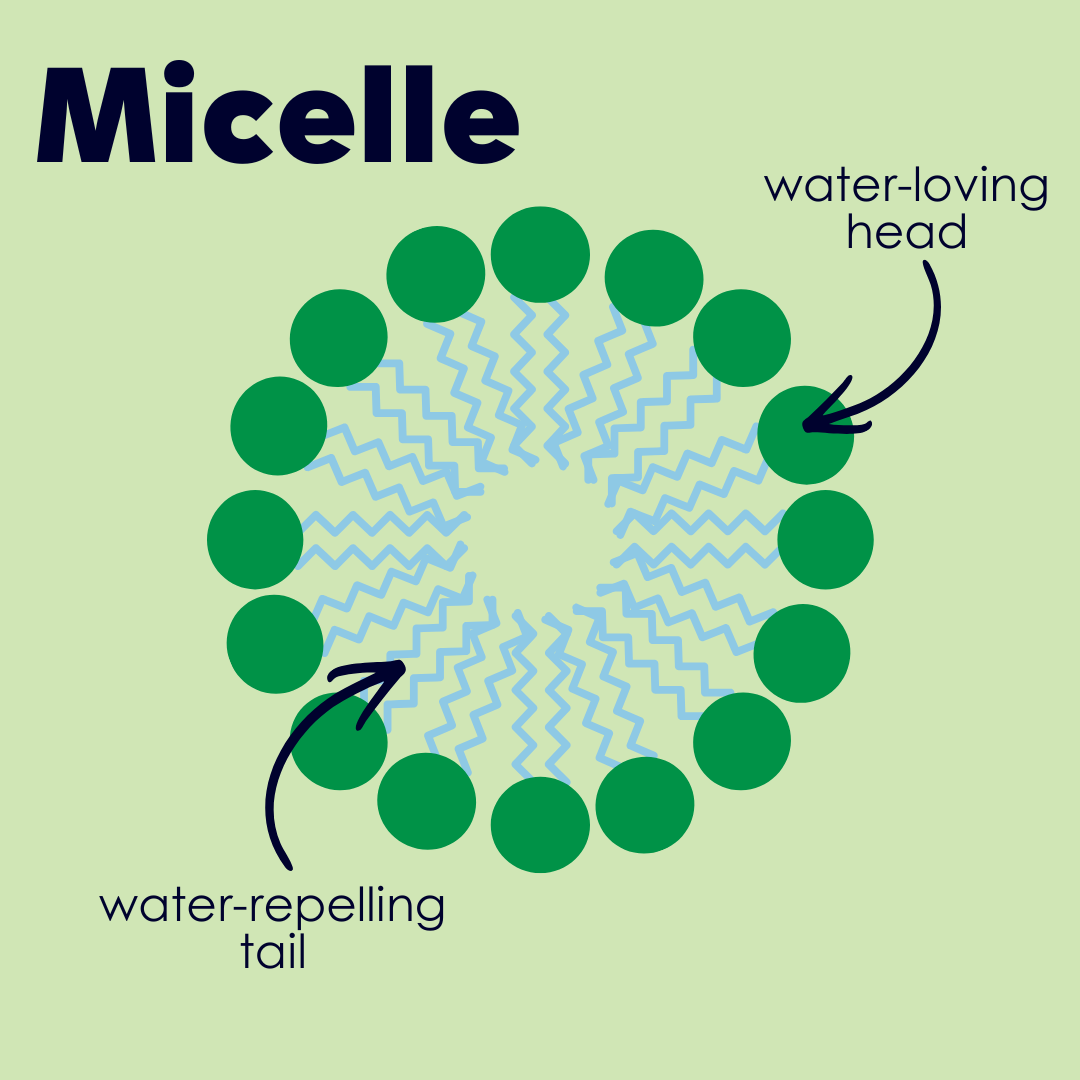
The name micellar water can make the critical micelle concentration sound like a finish line. It is better understood as a condition-dependent threshold at which surfactant molecules begin forming aggregates in solution. Crossing it does not establish how effectively a cotton pad removes sunscreen, how much surfactant remains on skin, or whether the liquid feels clean rather than slick or faintly soapy.
The surrounding formula matters. This one contains sodium lactate, sorbitol, panthenol, sodium phytate, aloe juice, jasmine hydrosol, saffron extract, and a levulinate-anisate preservative blend. Electrolytes, botanical materials, pH, and other dissolved substances can alter surfactant behavior. A substitution can also change clarity and foam even when the finished active matter is normalized. Those outcomes require observation or testing, not inference from the word micelle.
The same limit applies to mildness. Sodium cocoyl glutamate is used in mild cleansing systems, but an ingredient-level description cannot settle the tolerability of a no-rinse finished formula. Concentration, contact time, wiping, the rest of the composition, and individual skin response remain part of the exposure.
Several preservation systems are entering one batch
The posted percentages describe a formula that is mostly botanical water. Its jasmine hydrosol is specified as already preserved, and its aloe concentrate is also described as preserved. Their preservation ingredients are not included in the displayed INCI details. An aqueous saffron material adds another supplier-defined composition, followed by 3% of the named preservative blend in the final batch.
Pre-preserved inputs can be entirely appropriate. They do not make the finished preservation system predictable by addition. Preservatives have working pH ranges and can be affected by the formula matrix, packaging, raw-material bioburden, and interactions with other ingredients. Disinfecting a beaker lowers one source of contamination; it does not demonstrate shelf life.
ISO 11930 describes preservation efficacy testing as a reference method for evaluating the antimicrobial protection of cosmetic formulations, particularly water-soluble or water-miscible products. The recipe itself acknowledges that challenge testing is needed to confirm preservation. That qualification is more consequential than the short mixing time.
What a reproducible version would identify
A technically portable formula would give another formulator enough information to rebuild the same system. At minimum, that record would include:
- the manufacturer and exact grade of each composite raw material;
- the active matter of the supplied surfactant and the intended finished level;
- the complete supplier INCI for preserved hydrosols, aloe, and extracts;
- the amount of acid or base used to reach the target pH;
- the packaging, batch conditions, and relevant stability and microbiological results.
Without those details, the formula is best read as a training prototype: a water-rich cleanser architecture with humectants, botanical materials, a chelator, surfactant, and preservation components. It is not evidence that every ingredient swap produces the same micellar water.
There is also a clear boundary between making a personal trial and placing a cosmetic on the European Union market. Regulation 1223/2009 requires a responsible person, good manufacturing practice, a safety assessment completed before market placement, a product information file, and notification. A recipe and a clean-looking bottle do not perform those functions.
The bounded answer is not that the five-minute batch is inherently unsafe or ineffective. It is that the written ingredient name leaves the cleansing dose unresolved until the commercial grade is known. The useful first question is therefore not whether sodium cocoyl glutamate can be swapped for a glucoside. It is: how much active surfactant does each supplied material place in the finished bottle?
Sources: Zschimmer & Schwarz · BASF · ISO · EUR-Lex